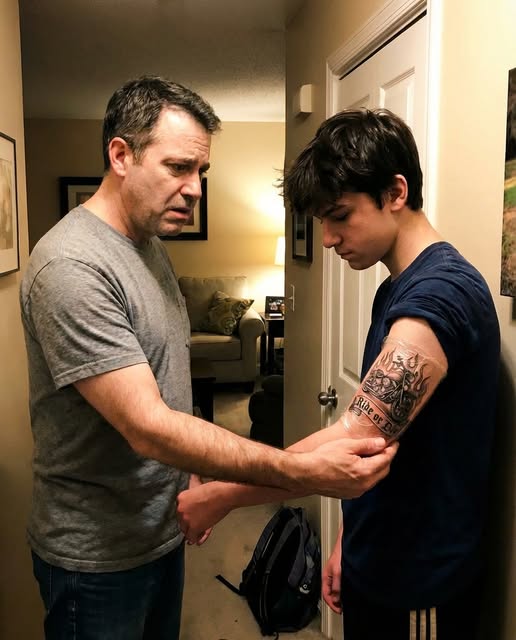
It was an ordinary Tuesday afternoon until it wasn’t. My sixteen-year-old son, Marcus, came home quieter than usual, his backpack slipping from his shoulder as he made a quick retreat toward his bedroom. Something in his posture told me this wasn’t just a long day at school. When I gently called him back and asked what was going on, he hesitated before rolling up his sleeve. Beneath a layer of fresh wrap was a new tattoo — a motorcycle framed in flames with the words “Ride or Die.” The air left my lungs. It was the same design my younger brother Jake had worn years ago, before we lost him nearly two decades earlier.
The shock ran deeper than parental surprise. I had never shown Marcus photos of Jake’s tattoo, and I rarely spoke about that chapter of my life. My brother and I had shared a bond built on adventure and loyalty, but his sudden passing left behind grief I tucked away rather than processed. Marcus told me he chose the design from a shop’s sample book because it “just felt right.” That explanation only deepened the mystery. How could my son unknowingly select something so closely tied to our family’s history? The coincidence forced me to revisit emotions I had long tried to sidestep.
Seeking clarity, I visited the tattoo studio Marcus mentioned. What I found there surprised me. The artist, Danny, turned out to be one of Jake’s longtime friends. On the studio walls hung old sketches and artwork my brother had created years before. The design Marcus chose wasn’t random — it had originally been drawn by Jake himself. Seeing those pieces again stirred both sorrow and warmth. What once symbolized only loss now felt like proof that creativity and connection endure, even when time moves forward.
That evening, my conversation with Marcus shifted. Instead of focusing on frustration, we spoke openly about family, legacy, and the stories that shape who we are. I shared memories of his uncle — the laughter, the road trips, the lessons about loyalty and courage. The tattoo transformed from a source of shock into a bridge between generations. Sometimes, healing doesn’t mean forgetting. Sometimes, it means allowing the past to resurface in a new way — one that brings understanding, connection, and a deeper appreciation for the threads that quietly bind families together.