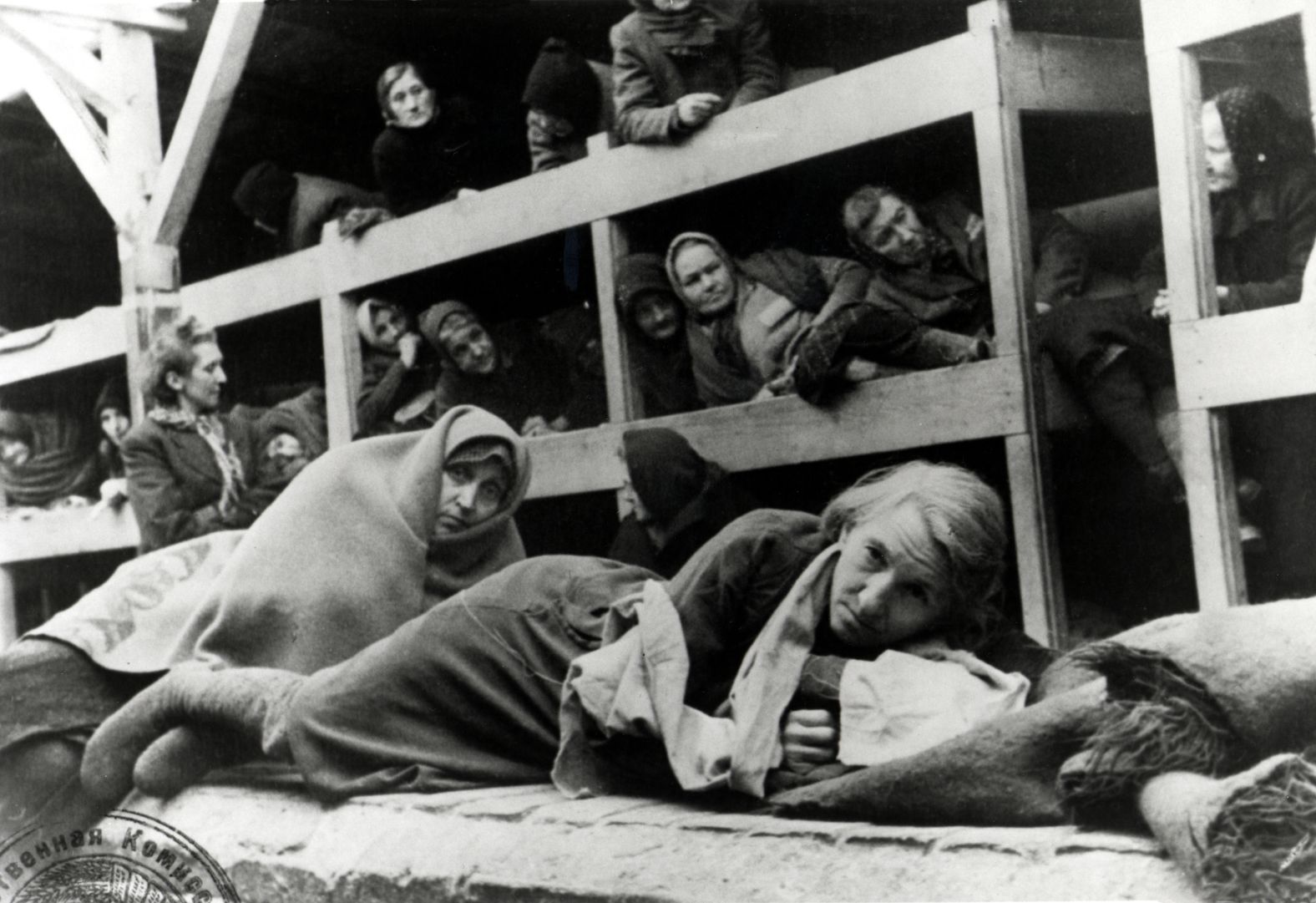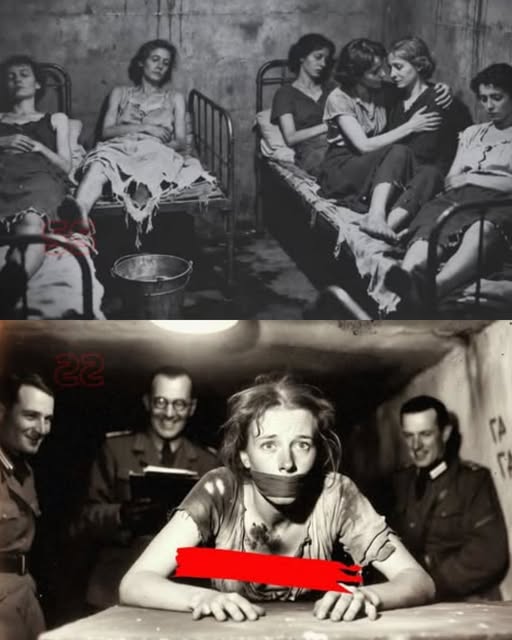
Marguerite Delorme did not understand the significance of the place at first, because fear often disguises itself as confusion before it reveals its full weight.
The cellar smelled of damp stone, disinfectant, and something metallic that no amount of cleaning ever seemed to remove from the air.
The guards spoke little, not out of discipline, but because words were unnecessary in a space designed to strip people of explanation and expectation.
Room 47 was smaller than she imagined, its walls reinforced and bare, illuminated by a single bulb that hummed relentlessly, as if refusing to allow silence any authority.

Women were brought there individually, never together, ensuring that isolation did the work long before any command was issued or any rule enforced.
Marguerite noticed that time behaved differently inside that room, stretching moments into hours and compressing entire nights into fragments that memory would later struggle to arrange.
She was asked the same questions repeatedly, not because answers mattered, but because repetition weakened certainty and blurred truth into something easier to control.
Her insistence that she was only a nurse seemed to irritate them more than open defiance might have, as if compassion itself were a provocation.
What occurred in Room 47 was never recorded, yet its effects were visible in the way women returned to their cells quieter, slower, and visibly altered.
Some refused food afterward, others spoke to no one, and a few stared at their hands as if they no longer recognized them as belonging to their bodies.

Marguerite learned quickly that survival required detachment, a careful separation between the mind that observed and the body that endured.
She focused on details that felt neutral, counting breaths, memorizing cracks in the wall, reciting pharmaceutical formulas to anchor herself to her former life.
At night, the factory above groaned with wind and settling beams, sounds that echoed downward and merged with whispered prayers from neighboring cells.
The guards changed frequently, but the room remained constant, an unspoken agreement that certain places existed beyond accountability.
Weeks passed, measured only by the fading strength in Marguerite’s legs and the gradual dulling of her sense of time.
She was eventually transferred back to general detention without explanation, her usefulness apparently exhausted, her fate postponed rather than decided.
No apology was given, no record amended, no acknowledgment offered that her presence in Room 47 had ever occurred.
After her release months later, Marguerite returned home to Roubaix, but the home she entered no longer matched the one she remembered.

Her father aged rapidly, her mother avoided questions, and neighbors spoke in careful tones that suggested relief mixed with discomfort.
Marguerite resumed nursing after the liberation, though she avoided enclosed spaces and refused assignments in basements or underground wards.
She treated others with precision and care, yet rarely spoke of herself, as if language had limits she no longer trusted.
Room 47 was officially nonexistent after the war, dismissed as rumor, exaggeration, or enemy propaganda by those eager to restore normalcy.
Yet dozens of women carried the same unspoken memory, recognizing each other through gestures rather than testimony.
Some attempted to speak publicly, but their accounts were often softened, questioned, or quietly redirected toward more comfortable narratives.
Marguerite chose silence for many years, not out of shame, but out of exhaustion with explaining pain to those unwilling to hear it fully.
It was only decades later, when documents surfaced and witnesses aged, that fragments of the truth began to surface in footnotes and local archives.
Room 47 remained absent from official maps, yet present in survivor testimonies that matched too closely to be coincidence.

Marguerite died in 1998, leaving behind journals that spoke not of revenge, but of responsibility and memory.
She wrote that the greatest danger after conflict is not cruelty, but forgetting how easily ordinary systems allow it to occur.
Today, the factory in Lille has been converted into apartments, its cellars sealed and repurposed, its past buried beneath renovation.
Residents walk those corridors unaware, while history waits patiently for someone willing to look beneath the surface.
Room 47 no longer exists physically, but its legacy endures in the insistence that unnamed places still deserve to be remembered.
Because when stories disappear, conditions are created for their repetition, disguised under new uniforms and new justifications.
This article does not seek to accuse, but to document, not to reopen wounds, but to prevent the comfort of denial.
History is not only written in victories and dates, but in rooms without names and people who were never meant to survive them.
And as long as their stories are told, even softly, those rooms will never fully succeed in erasing what they tried to contain.